
Everyone Thinks They Have a Moat
We're all on the same treadmill, and we've all told ourselves the same comforting story. My prompts are special. My product is special. My taste is special. I, specifically, have earned some unique right to win this.
Look at what's actually happening and the story falls apart.
Almost everything is being commoditized in real time, in front of us, faster than we can update our own self-image. Coding. Design. Copywriting. Music. Images. Research. Even ideas now. The uncomfortable truth is that most of us are producing slightly different versions of the same useful slop and calling it a moat. It's useful, it sells, it helps people. But it isn't defensible, and defensibility was the whole thing we were promised.
Here's how deep it goes. I'm not even convinced the AI labs are winning, especially the American ones.
Think about the position they're actually in. They're spending amounts of money that would embarrass a small country to compete in a market with almost no stickiness, where prices are falling off a cliff, and where the products keep converging toward interchangeable. Every genuine breakthrough becomes a commodity API feature about six months later, shipped by three competitors at a fraction of the price. That's not a moat. That's a treadmill with a bigger electricity bill.
And the exits don't look kind. They may simply burn each other out, right up until Chinese and open-source models finish squeezing whatever margin is left. When the thing you sell is being given away by someone who doesn't need to make money on it, price stops being a lever you control.
So if the labs, with their billions and their genius clusters, are in a knife fight, what exactly makes the rest of us think our little wrapper is safe?
Most AI startups are in a stranger spot than they admit. They're building on top of something they don't own, at prices they don't set, making products that can be cloned before the next funding round even closes. That's not a company. It's a lease on someone else's advantage, and the landlord raises or drops the rent whenever it likes.
I want to be fair here, because there are real moats left. They're just not the ones people brag about. They're the boring ones: distribution, owning the customer relationship, proprietary data nobody else can reach, being genuinely impossible to rip out of a workflow. But notice that none of those are the AI. The AI is the commodity. The moat, if you have one, is the thing wrapped around it that has nothing to do with how clever your model is.
So who actually wins right now? In my experience, one group, over and over.
The operators. The people who specialize in asymmetric plays and just surf every wave they can find. I've written about them before and I keep coming back to them because they keep being right.
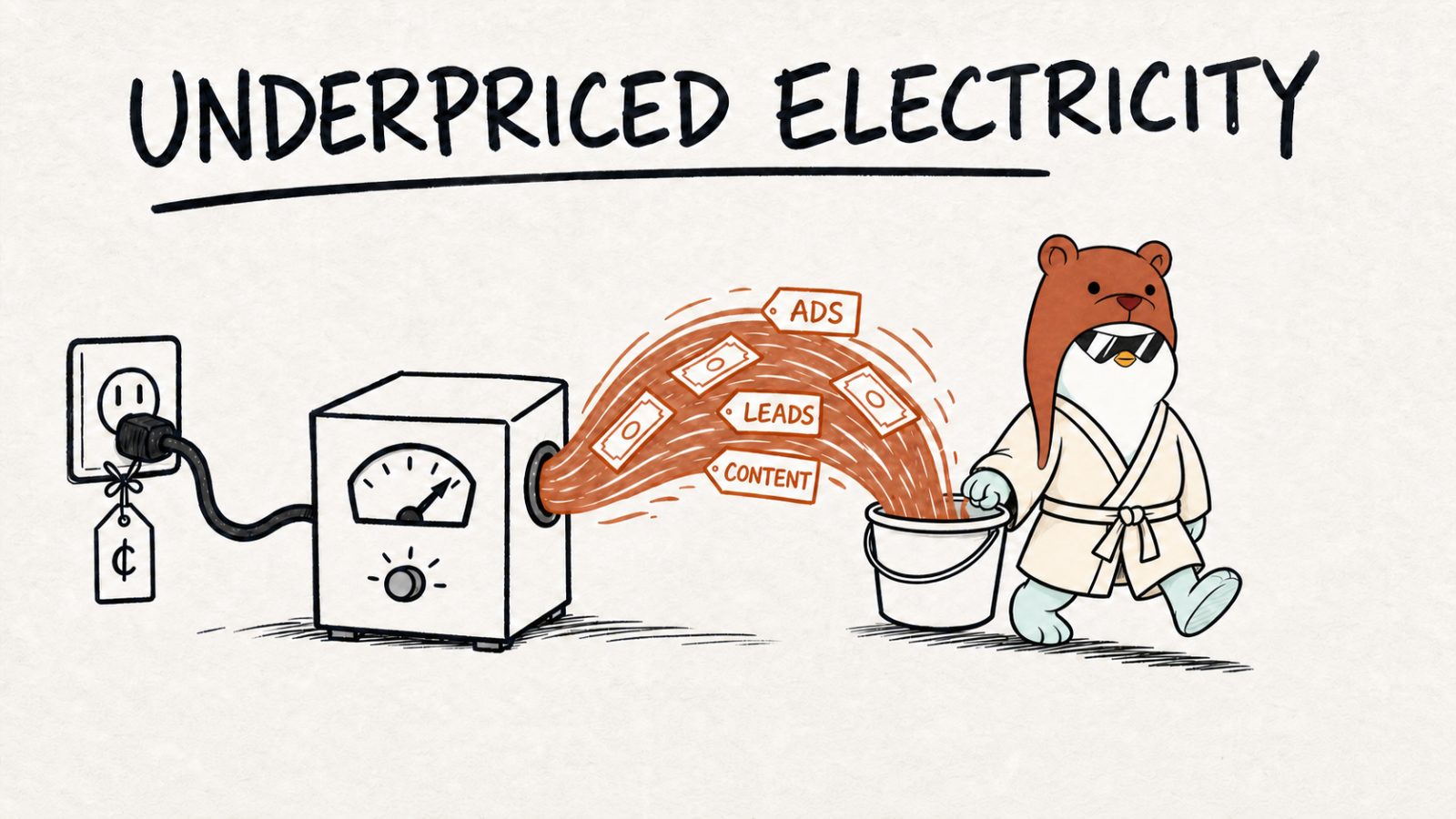
They don't need to own the model. They don't build the infrastructure. They don't discover anything fundamental. They just noticed the thing the moat-builders are too proud to act on: intelligence is being sold, right now, stupidly cheap. So they take a few thousand dollars of tokens and turn it into millions of ads, or leads, or pieces of content, or hours of automated labor. They grab the spread between what the intelligence cost and what the output is worth. Then, when everyone else catches on and the spread closes, they dip, and go find the next one.
They're not trying to build the definitive AI company. They gave up on that fantasy early, and it freed them. They're treating AI like temporarily underpriced electricity.
That's the part worth sitting with, because it isn't really a metaphor. It's just what's true. Intelligence is priced below what it's worth right now, the same way electricity was underpriced in the years after we learned to generate it cheaply and before the world repriced everything around it. That gap is the whole opportunity. Not the current itself, which everyone is about to have. The gap between what it costs and what it's worth, for as long as the market is slow to close it.
The mistake is spending this moment building a monument on top of something that's about to be everywhere and free. The move is to bill for the mispricing while it lasts, and to stay light enough to walk away when it corrects.
Stop trying to own the river. Everyone is about to have the river.
Just move faster than the water.